
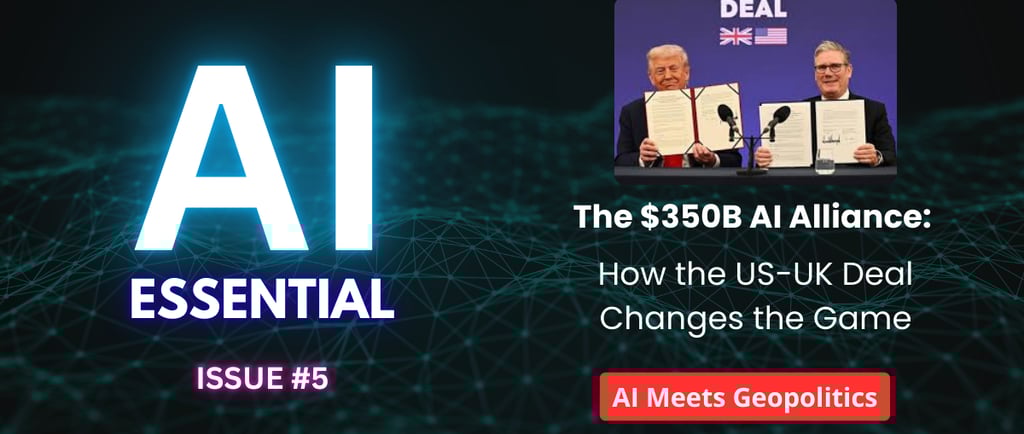
The $350B AI Alliance: How the US-UK Deal Changes the Game
A new US-UK "AI Alliance" has formed, backed by the largest bilateral tech pact in history and massive new commitments from Microsoft, Google, and Nvidia. AI is no longer just about building better models. It’s about geopolitics, infrastructure, and who controls the energy behind it.
AI ESSENTIAL
Eric Wabrick
9/22/20252 min read
AI Story of the Week
This past Thursday, President Trump and UK Prime Minister Keir Starmer signed the Tech Prosperity Deal — a $42B bilateral pact covering AI, quantum computing, and civil nuclear energy. It explicitly cuts Russia and China out of critical supply chains and positions the US-UK partnership as the democratic alternative to China’s state-directed model.
The private sector was already moving in lockstep. Microsoft is investing $30B over four years in UK AI infrastructure, including the country’s largest supercomputer (23,000 Nvidia GPUs). Google has pledged £5B (~$6.8B) over two years for data centers, R&D, and cloud expansion tied to DeepMind. Meanwhile, Nvidia is deploying 120,000 GPUs across UK data centers while investing £2B into British AI startups.
These corporate bets anticipated the alliance — and the $42B deal signed last Thursday makes it official. Together, they help form a $350B AI alliance between the US and UK. It also underscores a deeper reality: governments and companies alike are preparing for a future where demand for AI compute only accelerates.
Key Insights
AI Competition Just Became a Two-Bloc System → The pact removes the UK from Russian nuclear fuel by 2028 and cements US-UK alignment on AI safety and standards. We’re moving from a global AI race to an East vs. West Showdown.
Infrastructure Follows Geopolitics → Microsoft’s $30B buildout, Google’s £5B expansion, and Nvidia’s 120,000 GPUs weren’t isolated decisions. They were the private sector reading the geopolitical tea leaves.
Compute Capacity Is the New Bottleneck→ Nvidia’s GPU pledge and Microsoft’s supercomputer build show that scarcity isn’t about algorithms anymore — it’s about access to compute, energy, and favorable regulation.
Regional Strategy Beats Centralization → The deal includes “AI Growth Zones” in northern England to ease planning and energy constraints. Nvidia’s £2B startup fund targets Cambridge, Oxford, and Manchester — signs that the future of AI ecosystems will be distributed, not concentrated.
Why It Matters & How to Apply It
We now have competing blocs with distinct standards, supply chains, and regulatory environments. That fundamental shift carries massive implications for how businesses, investors, and technologists approach AI:
For business leaders → Your AI strategy now requires geopolitical analysis. Which bloc’s standards will your products follow? Which supply chains can you trust? Location matters — being close to Western AI infrastructure could cut costs, reduce latency, and smooth compliance.
For investors → Don’t just follow the technology — follow the bloc. Companies aligned with the Western AI alliance just gained structural advantages. Firms straddling both East and West face rising risk.
For technologists → $350B means unprecedented resources for Western AI R&D — but also unprecedented pressure to compete against China’s state-backed push. Innovation timelines will accelerate.
The Bottom Line
AI is no longer just about models or tools. It’s about where you operate, whose standards you follow, and who controls the power behind your compute. And above all, it’s about preparing for a future where demand for AI infrastructure continues to rise. Companies that factor geopolitics into their AI strategy will be the ones that stay competitive as the landscape continues shifting.
Connect
Explore our social media pages
Contact
Newsletter
724-801-1234
© 2025. All rights reserved.